
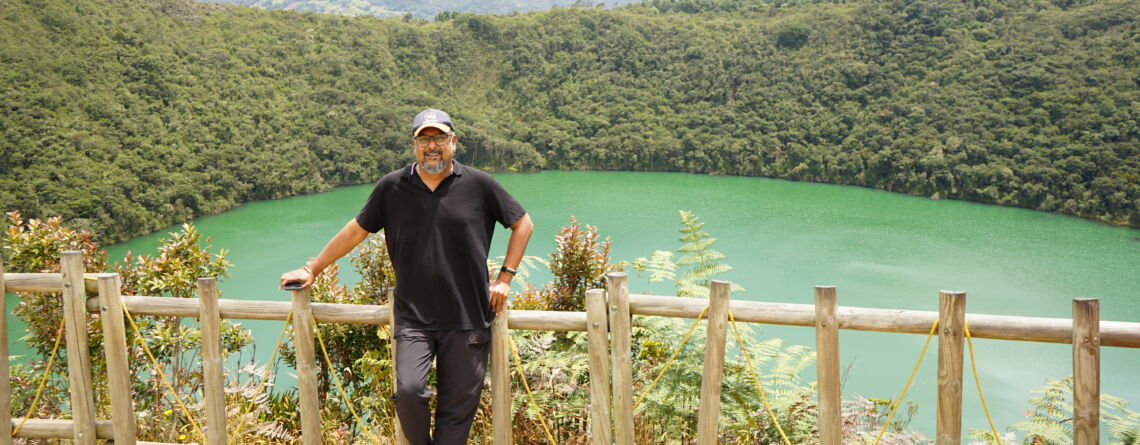
Laguna de Guatavita – Colombia
Guatavita and its famous Laguna has many myths swirling around it. The most famous and enduring one concerns the El Dorado…
There are myths that entertain. And then there are myths that move armies, bankrupt empires, and redraw maps. El Dorado belongs to the latter.
But like most things in Colombia, what the world thinks it knows… is only half the story.
Laguna de Guatavita – The Lake That Was Born of Fire and Time
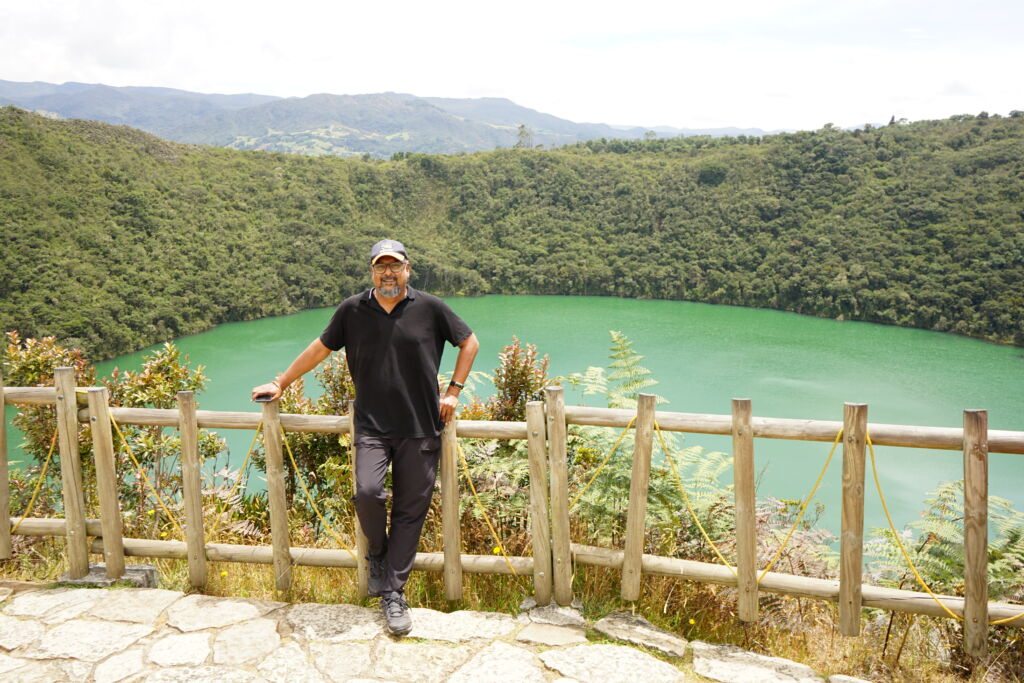
Laguna de Guatavita doesn’t feel accidental… Because it isn’t.
This near-perfect circular lake is actually a crater-like formation, created thousands of years ago when a salt dome beneath the earth collapsed. Over time, rainwater filled the depression, creating this almost geometrically precise basin, ringed by steep slopes, sealed off from the outside world.
It looks calm. Almost gentle. But it is, quite literally, a scar in the earth. And perhaps that’s why it became sacred.
The People of Gold: The Muisca Civilization of the Guatavita region
Long before the Spanish arrived with steel and scripture, the Muisca people lived here, part of the larger Chibcha-speaking cultures of the Andean highlands. They weren’t an empire in the way the Incas were. No vast armies. No dramatic conquests. Instead, they were something far more subtle. They were a confederation.
Two primary rulers governed the region:
- The Zipa of Bacata (present-day Bogota)
- The Zaque of Hunza (modern Tunja)
Around them existed a network of local chiefs, priests, and clans… a decentralized but deeply structured society. Power here wasn’t just political. It was spiritual. And that is where Guatavita comes in.
Gold Was Never Wealth
The Spanish obsession with gold came from a simple idea: wealth. The Muisca saw it differently. Gold, for them, was not currency. It was sacred. It represented the sun. Light. Divinity. They didn’t hoard it. They offered it. Which, in hindsight, must have seemed like absolute madness to the Spaniards.
The Ritual of El Dorado
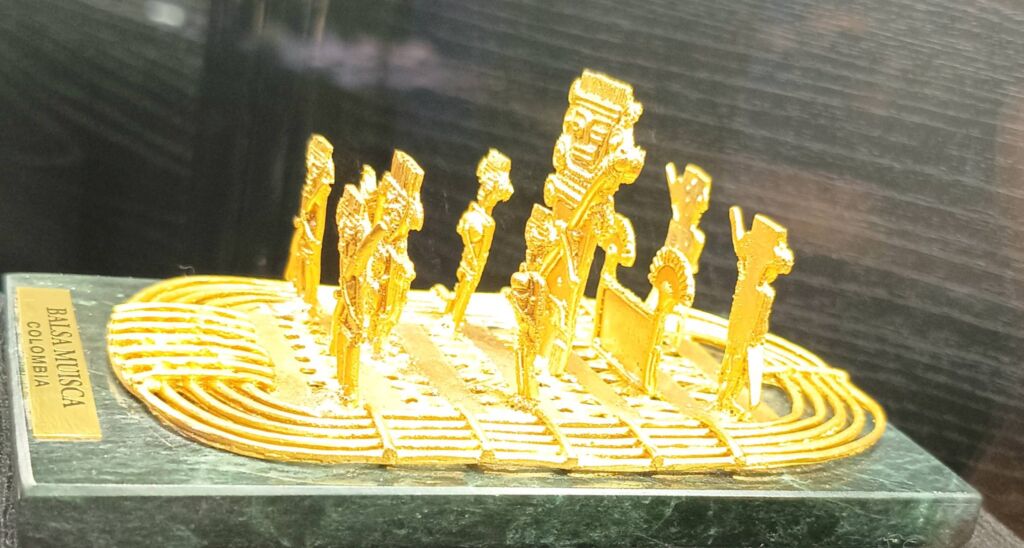
This tiny golden raft is one of the most powerful objects in South American history. It tells the story that sparked centuries of obsession. When a new ruler, the Zipa, was crowned, he underwent a sacred ritual at Laguna de Guatavita.
Covered in fine gold dust, he would step onto a raft made of reeds. Priests and nobles stood around him, carrying offerings of gold, emeralds, sacred objects… The raft would move into the center of the lake. And there, the Zipa would dive into the water. The gold washed away. The offerings were cast into the depths. A communion between man and the divine.
This is where the misunderstanding began. The Spanish didn’t see ritual. They saw opportunity. They heard of a “golden man” – El Dorado – and assumed it referred to a city, a kingdom, a place overflowing with riches.
The Spanish were chasing a metaphor. And they turned it into a map.
When Obsession Meets Destruction
The Spanish didn’t just search for El Dorado. They tried to drain the lake. Multiple expeditions attempted it over the 16th century. The most infamous was led by Antonio de Sepulveda in the 1540s. Thousands of indigenous laborers were forced to dig a channel into the crater wall to lower the water level. They succeeded… partially.
The lake dropped. Gold artifacts were recovered. But the cost? Immense. Lives lost. Land scarred. A sacred site violated.
Later attempts, including those by British investors in the 19th century, tried more “advanced” methods, including tunnelling and machinery. None truly succeeded. The lake resisted. And perhaps, in its own way, it still does.
The Forest That Guards the Lake
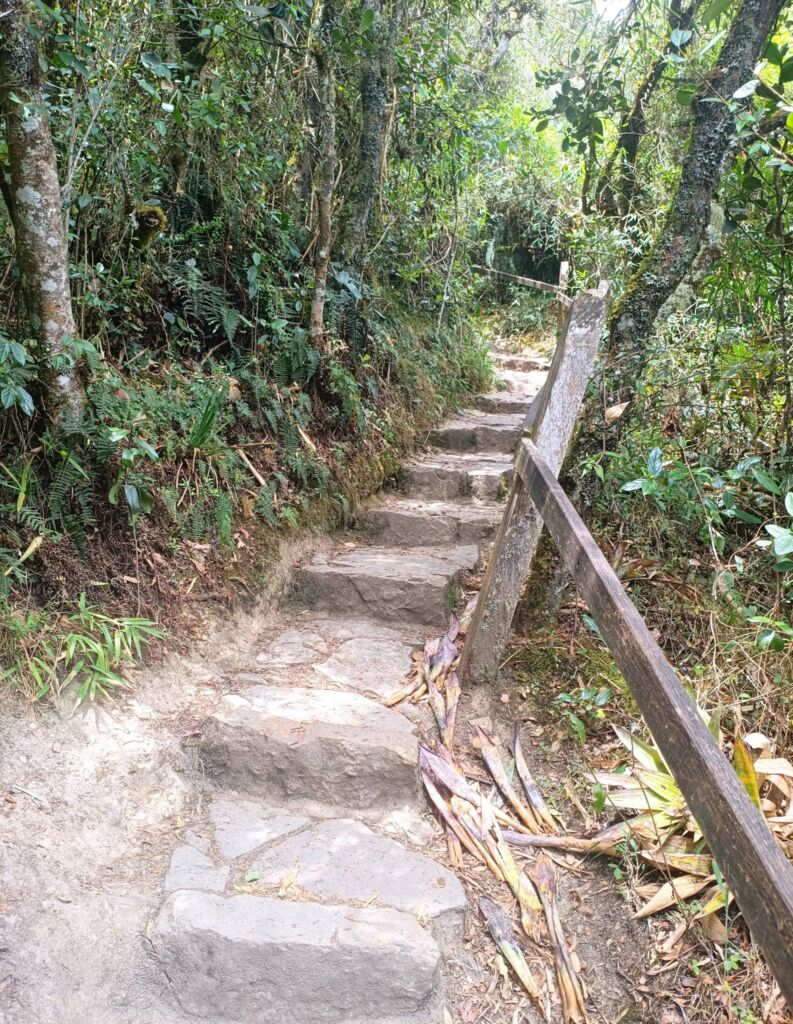
You don’t arrive at Guatavita casually. You walk. And the forest makes sure you earn it. This is Andean cloud forest — humid, dense, alive in quiet ways. The trail winds through:
- Moss-covered trees
- Ferns that seem older than memory
- Twisted roots gripping the earth like they’ve been here forever
And some of them have. There are trees here, native Andean species, that are hundreds of years old. Witnesses to rituals, invasions, silence, and time. You don’t always notice them immediately. But they notice you. The air is thinner here. Cooler. Slightly damp. Birdsong appears and disappears. And every now and then, the forest opens just enough to remind you that you are climbing towards something.
Flora, Fauna, and the Quiet Life Around You
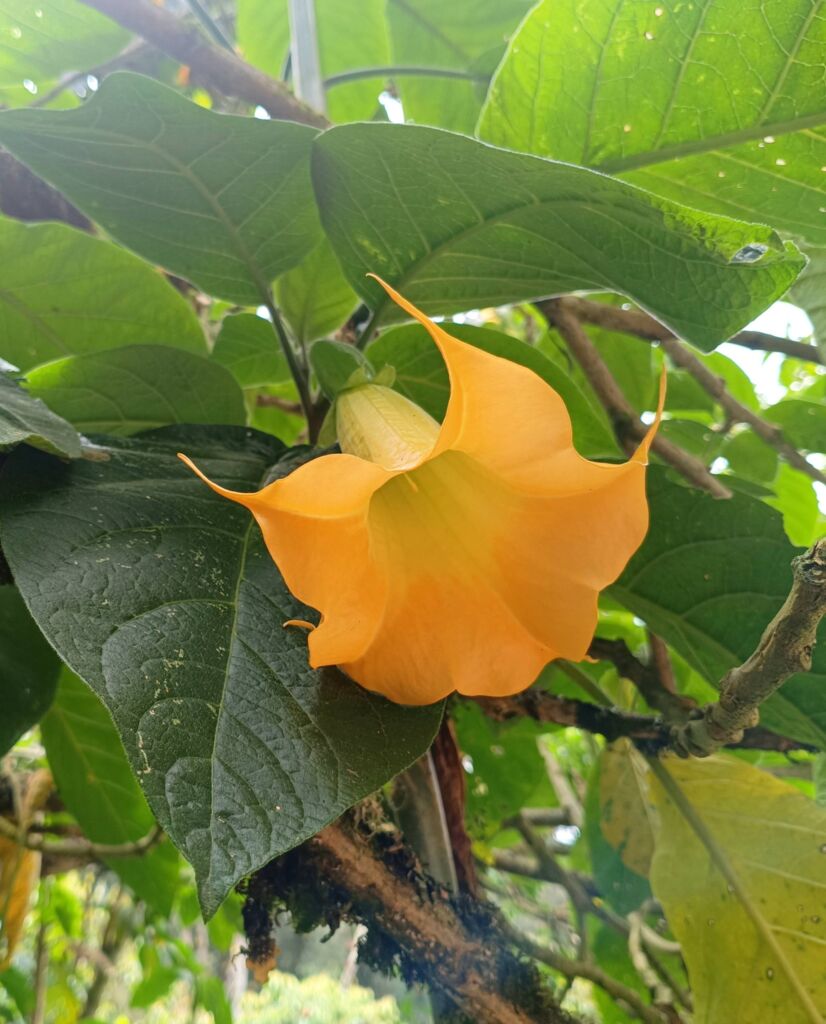
The ecosystem around Guatavita is subtle. It doesn’t overwhelm you like the Amazon. It whispers. You’ll find:
- Epiphytic plants clinging to tree trunks
- Wild orchids and trumpet-shaped flowers like the one above
- Small birds darting through the canopy
- Occasional sightings of Andean mammals, though rarely obvious
This is not wilderness that performs. It exists. And if you slow down enough, it reveals itself.
The Trek: A Slow Climb Into Silence
The walk up to the lake is not technically difficult. But it is deliberate. Stone steps, uneven at times. Gentle inclines that occasionally remind you that altitude is real. It’s less about physical effort and more about pace. You start talking. Then you slow down. Then you stop talking. And by the time you reach the top… You’re ready for the lake.
The Guatavita Lake Today: Sacred, Silent, Protected
Today, Laguna de Guatavita is protected. No swimming. No rituals. Not even gold-seeking madness. Just a quiet, watchful presence. The Muisca people still exist, though not in the form they once did. Colonization fractured their society, erased much, and forced assimilation. But in recent decades, there has been a revival of Muisca identity.
Communities around Bogota now actively reclaim:
- Language (Muysccubun)
- Ritual practices
- Spiritual traditions tied to land and water
Guatavita remains central to that identity. Not as a tourist spot. But as memory.
So What Was El Dorado, Really?
It was never a city. Nor was it a kingdom. It was a moment. A ritual. A man standing on a raft, covered in gold, stepping into a lake not to possess… but to offer. And somewhere in that difference lies the entire story of Colombia.
The Spanish came looking for wealth. The Muisca were practicing belief. The lake still holds both.
This was Part of the Mini Blogs on my travels in Colombia… Read the full travelogue here…
And just in case you want to visit Colombia, contact Beyonder Travel. Oh, and feel free to check out the other experiences across the world that are put up there…

Leave a Reply