
Candelabra of Paracas – Peru and the ancient India connection – Beyonder
Candelabra of Paracas – A Trident in the Sand, A Whisper from an Ancient time, and a Strange Echo from the Ramayana.
There are landmarks you visit with curiosity.
And then there are landmarks that stare back at you, raise one eyebrow, and ask, “So… what do YOU think happened here?”
The Candelabra of Paracas is definitely the second kind.
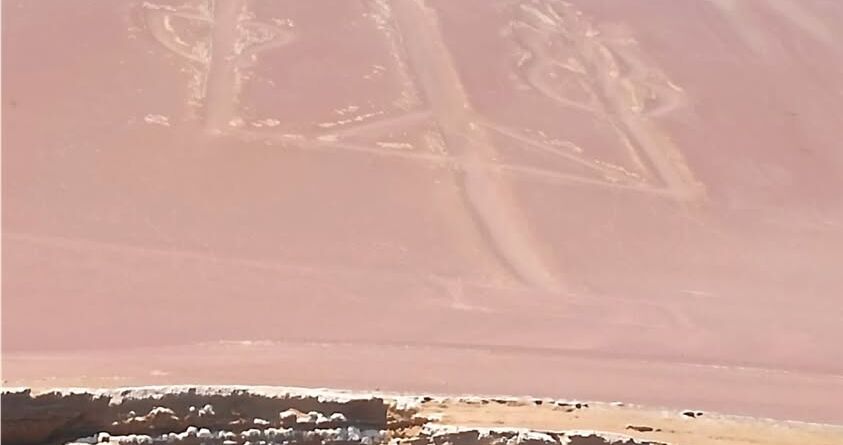
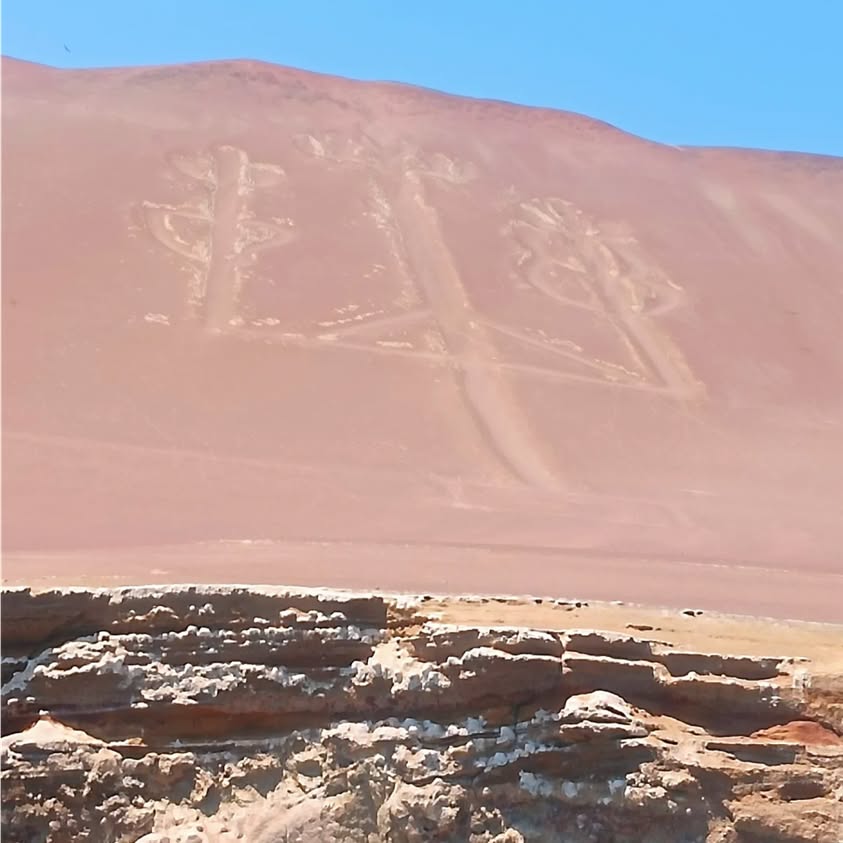
A gigantic geoglyph etched into the sandy hills of the Paracas Peninsula, visible only from the sea, shaped eerily like a trident, shining against the desert cliffs — bold, sharp, geometric, deliberate.
And the best part?
No one knows who made it.
Or why. Not even how. Or when exactly.
Perfect. Just the kind of mystery I like to trip over in the middle of a cool Peruvian morning.
The First Sight of the Candelabra of Paracas – Struck by a Symbol
You’re on the boat heading to the Ballestas Islands. The sea wind is crisp.
Pelicans are flying like drunken dancers. The cliffs rise in brown-and-gold folds.
And then suddenly — it appears.
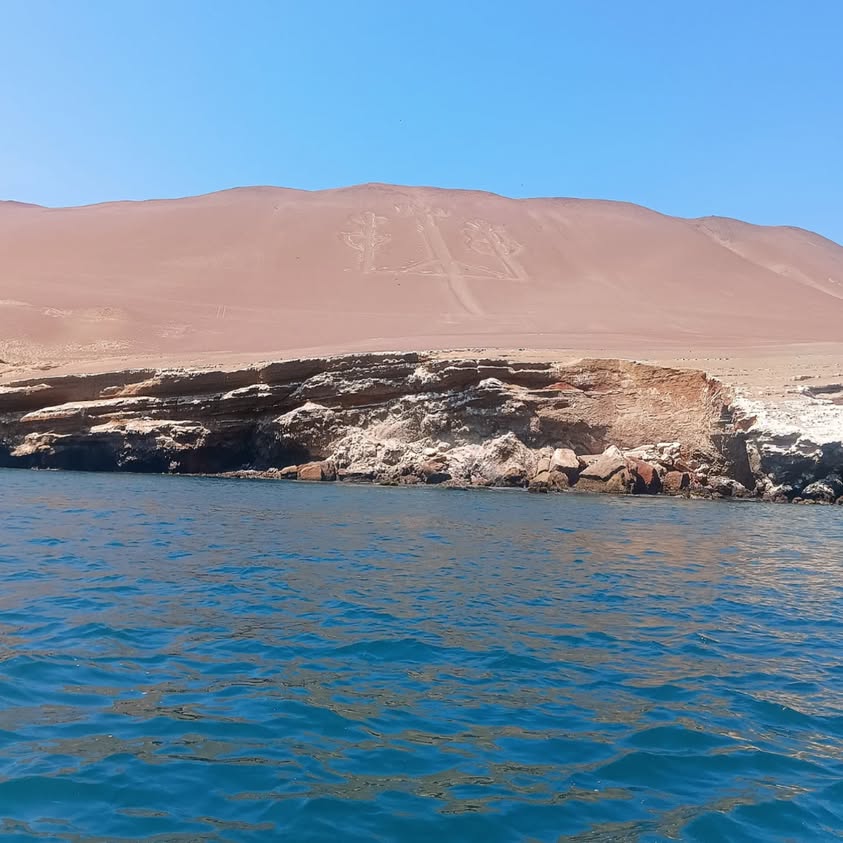 A giant trident.
Three-pronged.
Engraved deep.
Perfectly symmetrical.
Visible from miles away on the ocean.
And your brain goes:
Wait. Why does this feel familiar? Why does this look like a symbol from somewhere else entirely?
That was my moment. The moment I remembered something from Valmiki’s Ramayana — something that the Vanara King Sugreeva, of all people, said.
Let’s unpack that.
The Ramayana Connection with the Candelabra of Paracas – A Trident seen from the Sea
When Sugreeva sends his Vanara armies out in search of Mother Sita, he gives them directions — geographical directions — so detailed that modern researchers still scratch their heads.
To the group going East, he describes (translated):
“You will see the thousand-hooded serpent god Ananta, on a mountain visible from the sea.
A golden pylon with three branches — like a trishul — stands on the peak.”
When you read this, you shrug.
When you SEE the Candelabra of Paracas in real life…
You don’t shrug anymore.
The resemblance is uncanny.
The position — on a coastal mountain visible from the ocean — matches.
The three-pronged shape matches.
The symbolism matches.
Now — is this proof that ancient Indians visited Peru? No.
Is it absolute coincidence? Also no.
Because sometimes, myth leaves breadcrumbs disguised as geography.
So let’s see what the locals say.
What the Local Guides Tell You (And What They Don’t Know)
No guide pretends to know the truth.
But here are the theories floating around the Candelabra of Paracas:
A navigational marker for ancient sailors – A kind of lighthouse etched in sand — visible from afar, guiding ships.
A symbol of the Viracocha cult – The trident-like staff of the Andean creator god. Possible, because Viracocha is often depicted with branching scepters.
A map pointer toward the Nazca Lines – The Candelabra lies geographically in line with several Nazca geoglyph clusters.
A Paracas cultural symbol (200 BCE) – The Paracas people were known for complex textiles and geometric art — this fits.
Something entirely unrelated — a ritual site – The depth of the trenches suggests ceremonial importance.
Or… something older? Something pre-Paracas? Maybe something transoceanic? Something that aligns with myths from far-off lands?
Your boat captain shrugs. The archaeologist shrugs. And the local historian shrugs.
And then you realize that shrugging is part of the charm of the Candelabra of Paracas.
Because mystery is the point.
The Science behind the Geometry
Despite being carved into sand and rock over 600–900 years ago (or more), the Candelabra still looks fresh. Why?
The wind blows upward, not downward – This keeps the lines exposed.
The sand grains are cemented by prehistoric salt – A natural preservative.
The angle of the slope prevents erosion – Gravity works for the design.
The Candelabra is not a doodle.
It is an engineered symbol.
Someone — or some community — knew exactly what they were doing.
The Other Legends of the Candelabra of Paracas
Aside from the Ramayana echo, you’ll also hear:
The Viracocha Staff Theory – The creator god Viracocha walked across South America teaching humans art, architecture, morals — he carried a staff shaped like the Candelabra.
The Lightning Trident Theory – In Andean myth, thunder gods wield tridents.
The “Calling the Gods” Theory – Some shamans say the shape is a cosmic antenna.
The Astronomical Alignment Theory – Some believe the Candelabra points toward solstice sunrise lines.
Like all ancient cultures, Peru mixed:
- astronomy
- spirituality
- geometry
- ritual
Often in ways our modern minds struggle to interpret.
The Feeling – The part that Science doesn’t Explain
Standing on the boat, staring at that giant trident, I felt something very specific:
A sense of recognition. Not historical recognition — mythological recognition.
Human beings across continents have repeated symbols for thousands of years:
- the swastika (Harappan to Andean)
- the serpent gods
- the cosmic tree
- the sun spirals
- the trident
When symbols match across oceans, you have two choices:
- Believe in coincidence.
- Believe in a deeper human memory that predates our maps.
I, for one, prefer wonder over certainty.
The Boat Ride away – Where the Mystery Lingers
You speed away toward the Ballestas Islands. Sea lions bark in the distance.
Birds swarm overhead. Your mind is whirring.
The Candelabra of Paracas shrinks behind you. But the question stays:
What is this symbol doing here?
Why does it look so familiar?
How did it survive centuries of wind and sea?
Who carved it?
Was it a message? A marker? A prayer? A myth encoded in stone?
And more importantly:
How does Valmiki’s Ramayana describe the same thing?
You may never get a definitive answer.
But sometimes travel isn’t about answers.
Sometimes it’s about standing in front of a 2000-year-old trident-shaped enigma and feeling time fold gently on itself.
Why have I added this in my Peru series of Blogs?
Because Paracas is not “another stop on the itinerary.”
It is ancient Peru whispering a secret. Myth brushing against archaeology.
It is the place where your Indian identity and global curiosity suddenly sit down for a long conversation.
If Machu Picchu is Peru’s heart,
and the Amazon its lungs,
the Candelabra of Paracas is its question mark.
A perfect Beyonder destination.
A perfect “Don’t trip on the usual” story…
This was Part of the Mini Blogs on my travels in Peru… Read the full travelogue here…
And just in case you want to visit Peru, contact Beyonder Travel. Oh, and feel free to check out the other experiences across the world that are put up there…



Leave a Reply