
Prora in Rugen, Germany and the Eyes – A Beyonder trip
The Colossus of Prora is where Grandiose Dreams, Ghostly Eyes and a Glass of Whisky collided… for me… Ok, it was a few glasses maybe…
Some places don’t ask for your attention — they seize it.
Prora, on the Baltic Sea island of Rügen, is one of those places. If the world of travel were a bookshelf, Prora would be that strange, oversized tome wedged in the back corner… the one with the cracked spine, the yellowed pages, and a faint smell of history refusing to die.
Most travelers heading to Rügen chase postcard fantasies: chalk cliffs glowing like polished bone, breezy beaches, spa towns with pastel façades. And then there’s Prora — the hulking, unsettling, misunderstood giant that the Nazis left behind like a half-finished fever dream. Eight blocks, each the size of a small town. A mile-long monument to ambition, propaganda, and the bizarre intersection of leisure and dictatorship.
It’s off the beaten track, yes. But more importantly, it’s off the beaten mindscape.
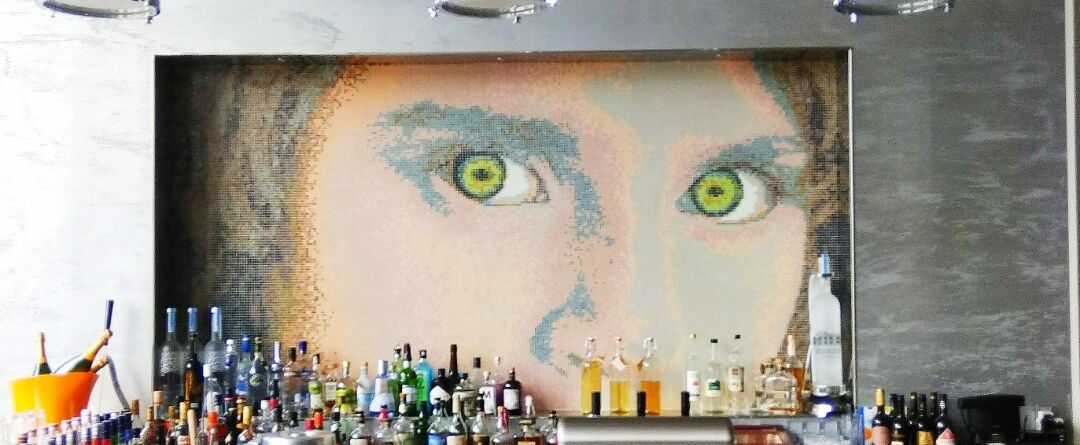
And once — many moons ago — I wandered into a bar inside this Colossus. I ordered a drink. And sat down. I looked up. And a pair of enormous green eyes stared right back at me from the wall.
The whisky swirled, the past swirled, the present swirled… and for a second, it felt like the building itself had woken up and was watching.
This blog is about that feeling — and the strange place that unleashes it.
PRORA: A RESORT BUILT BY A REGIME THAT HATED LEISURE
To understand Prora, you must first accept its bizarre origin story.
In the 1930s, the Nazi organization Kraft durch Freude (“Strength Through Joy”) dreamt up an idea: build a vast seaside holiday resort for “racially acceptable” Germans — a place where happy workers could sunbathe in perfect Aryan harmony under the benevolent gaze of the Führer.
A resort built not for tourism… but for control.
Not for joy… but for propaganda.
Not for escape… but for indoctrination.
Prora was meant to house 20,000 vacationers at once.
Imagine: endless grey corridors stretching into the distance, 10,000 identical rooms facing the sea, precision-engineered leisure. A holiday factory.
And then came World War II. Construction halted. Leisure turned into labor. Resorts turned into barracks. Joy turned into destruction.
The Colossus never lived the life it was built for.
Instead, like a rejected Frankenstein, it sat for decades — gigantic, misplaced, brooding.
THE GHOST YEARS: AFTER THE WAR, BEFORE THE REBIRTH
After 1945, Prora passed hands like a cursed heirloom.
- The Soviets used it as a military base.
- The East Germans used it as barracks and training grounds.
- After reunification, it crumbled quietly for years — windows broken, corridors echoing, concrete peeling like old skin.
Urban explorers, history nerds, Cold War junkies, wild-campers, and curious misfits tiptoed through its carcass. They spoke of eerie silence, of hallways that seemed longer than time, of entire sections where nature had begun reclaiming concrete.
In the world of abandoned places, Prora was the king.
AND THEN… THE REINVENTION
Germany, practical as ever, looked at this looming relic and thought: Well, we can’t keep ignoring this thing forever.
So, slowly and carefully, Prora began to morph:
- Sections became youth hostels.
- Others turned into vacation apartments.
- Some became museums and documentation centers.
- A slice morphed into a surprisingly stylish beach resort with bars, cafés and sun decks.
That’s how I ended up there — not as a historian, not as an urban explorer, not as a Nazi-architecture geek… but simply as a traveler chasing an offbeat curiosity on a Baltic island.
And that’s how I ended up staring at those eyes.
THE BAR, THE EYES & A GLASS OF WHISKY
The bar was deceptively modern — clean lines, warm lights, a clinking symphony of glass. But the moment I sat down and looked across the shelves of liquor, I froze.
A mural stared back at me.
A pair of massive green eyes — luminescent, arresting, unsettling.
Neither friendly nor hostile… just there.
Watching.
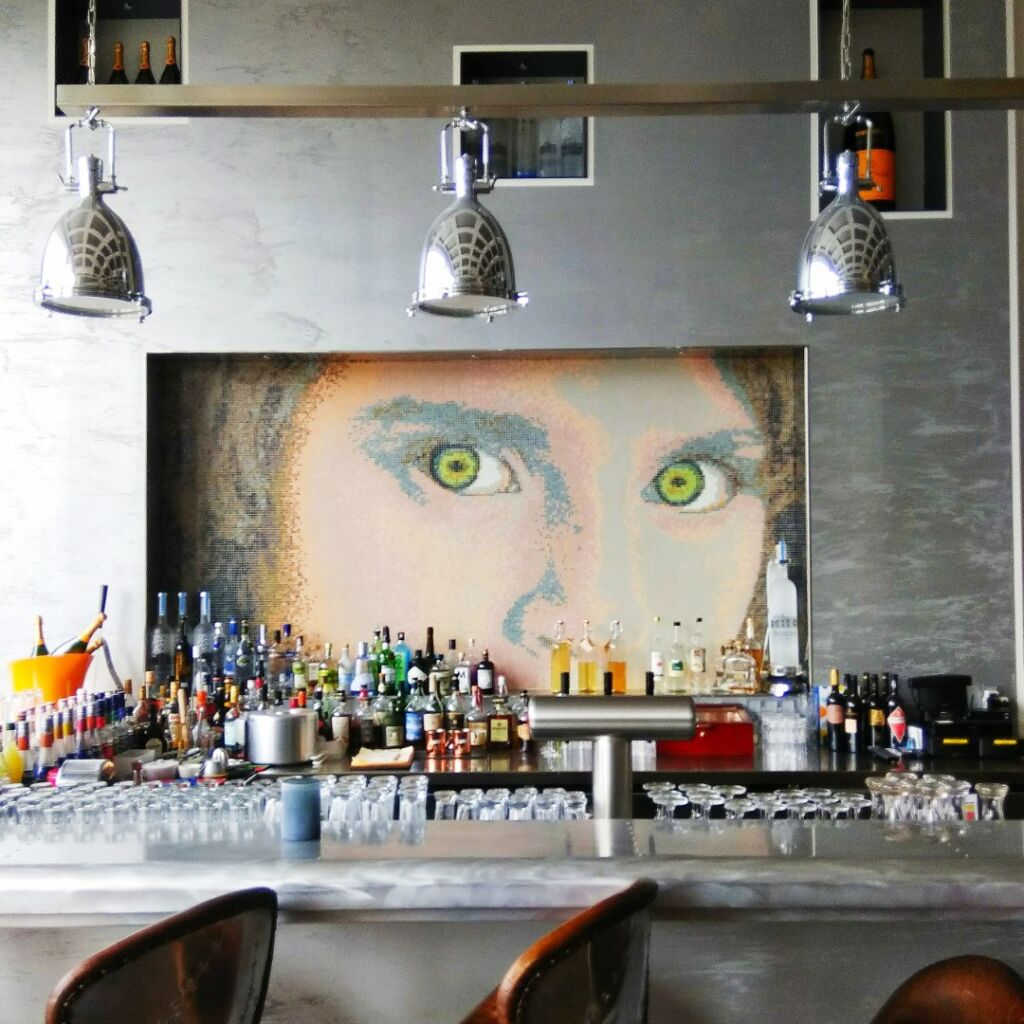
Those eyes weren’t Nazi relics, of course — just an artwork. But in Prora, everything carries echoes. Everything becomes a metaphor whether you want it to or not.
As I took a sip (ok, a few sips) of whisky, a strange swirl erupted in my head:
- Hitler’s manic architectural ambitions
- The machinery of propaganda
- The burden of history
- The eerie quiet of the Baltic Sea
- And… my wife’s eyes — warm, familiar, grounding (Ok, they were cold and accusing as the Whisky flowed)
All these eyes layered on those painted ones until the whole moment felt like a surreal cocktail of time, memory, and meaning.
Travel does that sometimes — it sneaks up on you, ambushes your senses, and gives you a moment you never planned for.
That night, Prora stopped being a building and became a sentient thing — alive with stories, staring back with those green eyes as if to say:
“You came for curiosity. Stay for the reckoning.”
ARCHITECTURE AS A MIRROR
Wandering through Prora the next morning, slightly (ok, very) hungover and still thinking about those eyes, I realized something: This building is a mirror.
Everyone who visits sees a different reflection.
- Historians see ideology.
- Architects see madness.
- Urban explorers see romance in decay.
- German teenagers see a cool beach hostel.
- Curious travellers like me see… all of the above, layered, contradictory, unresolved.
Prora forces you to sit with paradoxes:
- Beauty vs. brutality
- Leisure vs. oppression
- Nostalgia vs. guilt
- Vision vs. delusion
- Music in a modern bar vs. ghosts in the stairwell
Very few places in the world hold both past and present so tightly in the same concrete fist.
WHY PRORA BELONGS TO THE OFFBEAT TRAVELLER
Let’s be honest: Prora is not for everyone.
If you like clean narratives, gentle histories, or soft-edged tourist spots, Rügen offers plenty of alternatives.
But if you’re the kind who:
- Walks into abandoned spaces wondering what stories cling to the walls
- Likes your travel with a side of moral ambiguity
- Believes that history should be touched, not just read
- Thrives on the tension between what something was and what it has become
… then Prora is manna. Pure, potent manna.
It is one of the very few places on the planet where the journey is not just through rooms and corridors — but through ideologies, failures, reinventions, and the complicated rope of memory.
WHAT PRORA FEELS LIKE TODAY
Stand on the beach and look back at it.
The sea roars softly. The sky stretches endlessly. And the Colossus sits there — long, grey, and strangely beautiful.
A half-finished prophecy… And a titan too big to ignore.
A ghost too stubborn to die… And a resort too surreal to fully enjoy without thinking about its past.
Inside, the renovated sections feel fresh, bright, almost cheerful.
But the further you walk, the more the old Prora creeps up on you:
the echo of boots, the creak of empty staircases, the bleak geometry of fascist architecture.
You cannot shake off the feeling that you’re walking through the ribcage of history.
FINAL SIP
Prora is a reminder that travel isn’t just about beaches and sunsets and happy stories. Sometimes it’s about confronting the past, reckoning with memory, and finding yourself in the absurd intersection of history and a well-made drink.
It’s a place where you sip whisky under the gaze of painted eyes, and the entire timeline of the 20th century quietly rearranges itself inside your head.
Offbeat? Absolutely.
Unsettling? Yes.
Worth it? A thousand times yes.
Because some journeys don’t just take you to places — they take you to yourself.
And just in case you want to visit the region, contact Beyonder Travel. Oh, and feel free to check out the other experiences across the world that are put up there…

Leave a Reply