
Mount Kinabalu National Park — A Mountain That Teaches You How to Look
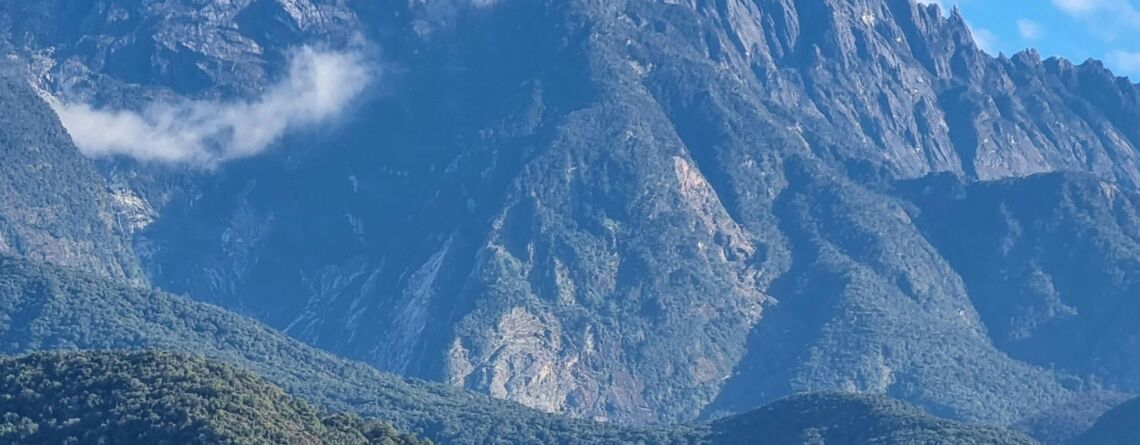
Mount Kinabalu does not need marketing. It does not try to seduce you with adjectives. It simply stands there — granite-heavy, cloud-wrapped, unconcerned.
At 4,095 meters, Mount Kinabalu is the highest peak in Southeast Asia. But height, as I discovered, is the least interesting thing about it.
Mount Kinabalu sits inside Kinabalu National Park, Malaysia’s first UNESCO World Heritage Site, recognized not for dramatic scenery alone, but for something rarer: biological density. This park holds an absurd concentration of life — more species per square kilometer than most places on Earth. It is a reminder that nature, when left alone long enough, tends toward extravagance.
Mount Kinabalu – A mountain older than ambition
Geologically, Mount Kinabalu is young — a granite intrusion that pushed its way up through the Earth’s crust a mere few million years ago. Biologically, however, it is ancient. The forests that cloak its lower slopes belong to one of the oldest rainforest systems on the planet.
Walking here is like walking through time zones.
At the lower altitudes, you begin in lowland dipterocarp rainforest — tall, cathedral-like trees, filtered light, humidity that settles into your bones. Higher up, the forest changes its mind. Trees shrink. Moss appears. Leaves thicken. The air cools. Eventually, vegetation gives up altogether, replaced by bare granite and sky.
Few places allow you to physically experience ecological succession in such a compressed, legible way. You don’t read about it. You walk through it.
The Mount Kinabalu trek: democratic suffering
Climbing Mount Kinabalu is not a technical mountaineering challenge. You don’t need ropes, crampons, or a heroic biography. What you do need is patience, reasonable fitness, and respect for altitude.
The trail is well-marked, occasionally steep, often relentless. Steps appear where you wish there weren’t any. The mountain doesn’t trick you; it just asks you to keep going.
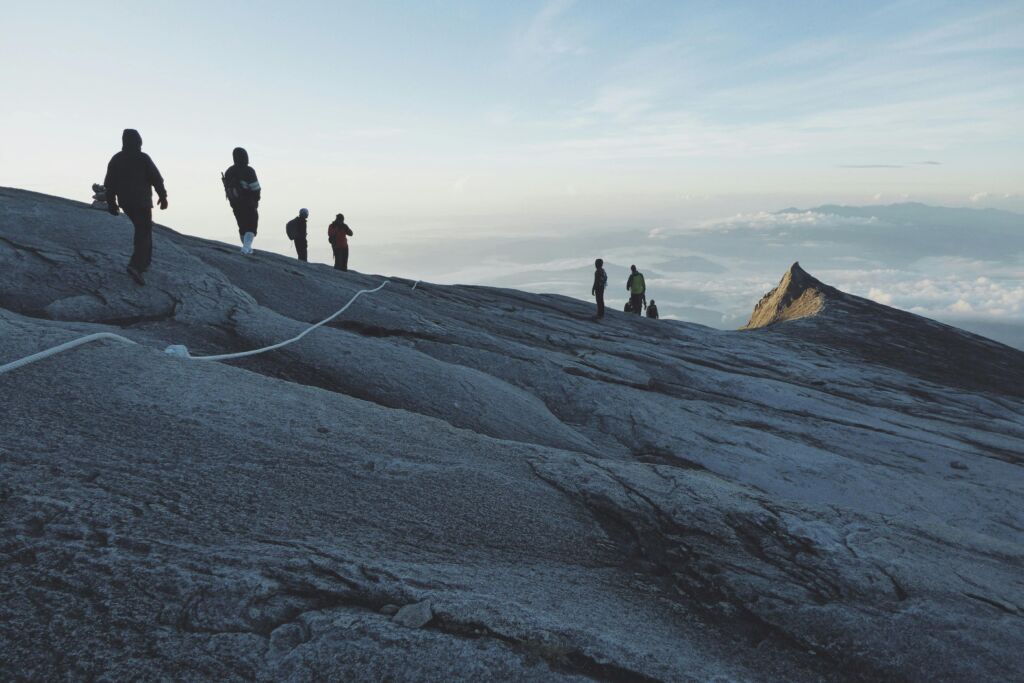 There is a certain egalitarian quality to the climb. Everyone moves slowly. Conversations fade. Breath becomes the main currency. You start noticing details you would normally miss — a pitcher plant by the trail, a bird call you can’t place, the way the forest smells different as you gain height.
Near the summit, the world simplifies. Rock. Wind. Sky. Dawn arrives quietly, spilling light over clouds gathered far below. It is not triumphant. It is matter-of-fact. The mountain does not congratulate you.
Kinabalu beyond the summit
What makes Kinabalu National Park special is that you don’t need to summit the mountain to experience its depth.
The park offers botanical trails, canopy walks, and short hikes that reveal extraordinary biodiversity without physical punishment. This is orchid territory — Kinabalu alone is home to thousands of plant species, many endemic, many still being studied.
There are pitcher plants that eat insects, mosses that thrive in perpetual damp, and flowers that bloom briefly and vanish without ceremony.
This is not nature curated for spectacle. It is nature continuing its work, largely indifferent to your presence.
A mountain with a memory
Local Kadazan-Dusun communities consider Kinabalu sacred. The name itself is believed to derive from Aki Nabalu — “the place of the ancestors.” Spirits, memory, continuity. Long before UNESCO badges and trekking permits, this was a mountain with meaning.
That matters.
Mount Kinabalu teaches you something simple and increasingly rare: scale without ego. You leave fitter, yes. But more importantly, you leave recalibrated.
This was Part of the Mini Blogs on my travels in Borneo… Read the full travelogue here…
Check out the Borneo packages available for you to choose from. Need something different? Contact Beyonder Travel.


Leave a Reply